Walk Royal Poinciana Way at seven o'clock on a Tuesday in August and you'll notice something that would have been unthinkable five summers ago: a line. Not a long one, and not for a table with a season-long waitlist, but people are standing outside a restaurant on the water in the middle of August, on an island that has spent a century training its residents to expect nothing but shuttered windows and taped-up signs until October.
That's the assumption worth checking this year. For as long as anyone who's lived here can remember, Palm Beach in summer meant white tablecloths in storage, patio furniture stacked against a wall, and a handful of old standbys running skeleton hours until the snowbirds came home. The rule wasn't wrong. It was just built around restaurants that only made financial sense for eight months a year. What's changed isn't the heat. It's that the newest additions to the island's historic core were never built to run on that same eight-month math.
The Rule Was Never About the Food
Old Palm Beach dining rooms shut down every summer for the same reason: overhead didn't pencil out without season traffic. A restaurant that depends entirely on white-tablecloth turnover from November through April has no cushion when that traffic disappears for four months. Air conditioning bills climb, staffing gets harder to justify, and closing the doors becomes the rational move rather than the sad one.
That math hasn't disappeared. It's still why so much of the island's dining scene contracts every summer. What's different this year is that a cluster of new venues sitting inside the same three or four blocks were never built on restaurant-only economics in the first place. They're part of a mixed-use property that was designed, from the start, to make money on retail, events, and foot traffic even when the dining room is half full.
What Happened at the Old Playhouse Site
As the Palm Beach Civic Association reported, the clearest evidence is sitting on the site of the old Royal Poinciana Playhouse, the theater that opened in 1958 and became a social center for the island in the 1960s and 1970s when it featured tours of Broadway plays, ballets and musical performances and drew A-list celebrities including Bing Crosby and Bob Hope. The building sat closed for years before construction began in 2022 on the redevelopment of the historic landmark at 70 Royal Poinciana Way into a mixed-use building with upscale retail, a 200-seat waterfront restaurant, and cultural arts venue with up to 400 retractable seats, a plan approved by the Town Council and Landmarks Preservation Commission in 2022.
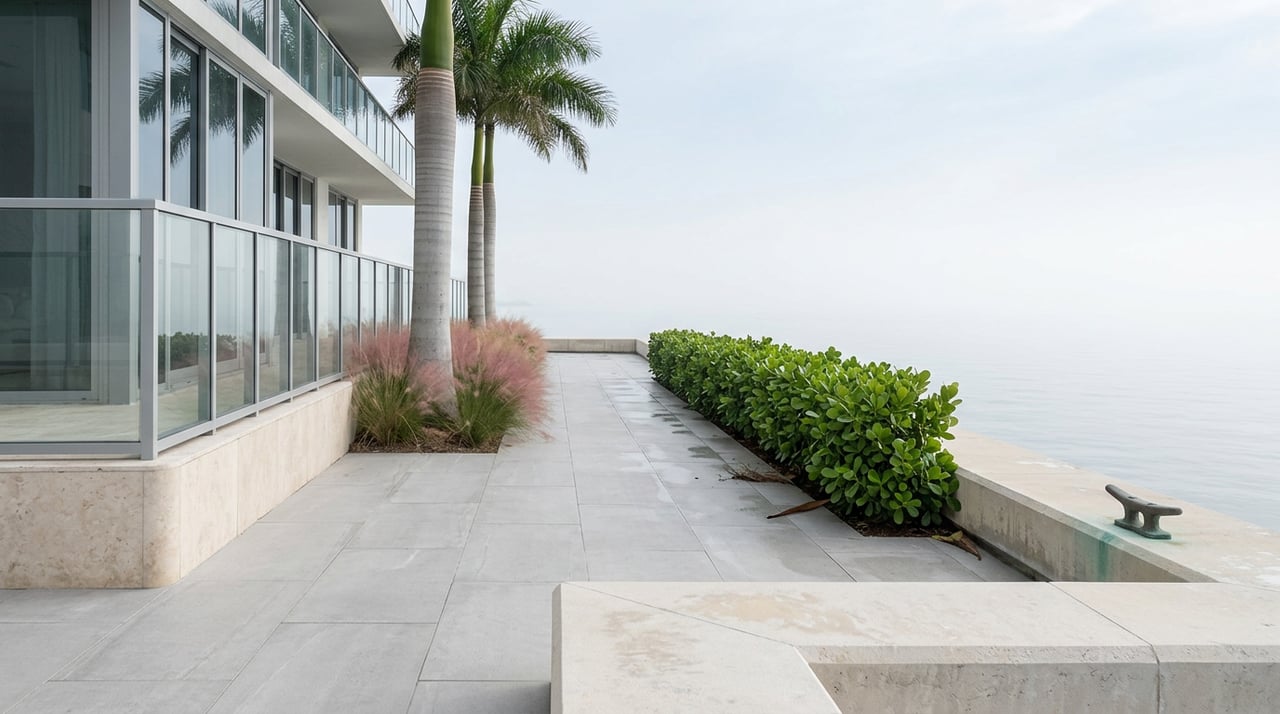
Tutto Mare, the restaurant, opened in January 2026 in what used to be the theater's Celebrity Room. The space includes a new indoor bar and lounge area in the former Celebrity Room with the ceiling mural preserved, an indoor dining room with views of Lake Worth Lagoon, outdoor dining, and a canopied, landscaped walkway connecting it to the plaza. WS Development's senior vice president of asset strategy told the Palm Beach Civic Association plainly what that means for anyone who lives here: Tutto Mare will be "the only waterfront restaurant open to the public on the island." Not the only one open in season. The only one, period.
Two blocks over, The Vineta reopened with its own additions this year. Coco's, the courtyard restaurant, brings over dishes from the Hôtel du Cap playbook, including steak Diane, set inside a restored 1920s courtyard rather than a hotel dining room. The Vineta Bar reworks the space that used to hold the old Leopard Lounge into a new cocktail room, a detail that means something specific if you've spent a decade or two on this island and nothing at all if you haven't.
Glazer Hall Gives the Playhouse a Second Life
The cultural half of the old Playhouse site matters just as much as the restaurant. The 24,000-square-foot arts center is two floors tall with offices and meeting space overlooking the performance area, equipped with 16 rows of retractable seating, a state-of-the-art sound system, and a flexible design built to accommodate music, film, dance, comedy, cabaret, and spoken-word presentations. It's run by The Innovate, a non-profit co-founded by long-time Palm Beach residents Avie and Jill Glazer, and was expected to open before the start of the 2025-26 season. Which means this August is its first real off-season test. A theater built to program year-round rather than one that goes dark the moment the season crowd leaves is a genuinely different kind of venue for this island to have.
The Plaza Was Built for This Long Before the Playhouse Reopened
None of this happens in a vacuum. Royal Poinciana Plaza itself, designed in 1957 by John Volk and laid out across 190,000 square feet around two central courtyards, has operated on a mixed-use model for years, mixing retail, food, and events in a way a single restaurant never could. Years before Glazer Hall or Tutto Mare existed, WWD reported that WS Development's chief operating officer described the philosophy behind that mix in blunt terms.
"You have 12 months of business here."
The quote is old, dating back to when the plaza's retail turnaround was still new. But it's the reason this summer looks different from the ones before it. A plaza built around shops, galleries, and pilates studios that draw locals in July just as easily as October gives a restaurant sitting inside it a customer base a stand-alone dining room never had.
A Working Round of the Neighborhood, August Edition
Here's what an actual evening looks like right now, without leaving the historic core on foot:
| Stop | What It Is | Why It's Different This Summer |
|---|---|---|
| Tutto Mare, Royal Poinciana Plaza | Waterfront dinner on the Intracoastal | Only public waterfront restaurant on the island, open through summer |
| Glazer Hall, the old Playhouse | Live performance, 16 rows retractable seating | First off-season in operation, no seasonal dark period |
| Coco's, The Vineta | Courtyard dinner, French Riviera menu | Runs on a hotel-adjacent model built for year-round covers |
| The Vineta Bar | Cocktails in the old Leopard Lounge space | New life for a room that used to close with the lounge scene |
If you live in the stretch between Sunrise Avenue and Royal Palm Way, that whole loop is a walk of a few minutes, not a drive across the bridge to Flagler Drive or the NORA District in West Palm Beach.
The Four Arts Never Actually Stopped
It's worth remembering that one island institution never bought into the shutdown script to begin with. Founded in 1936 to bring cultural programming to the resort community, the Society of the Four Arts runs a dynamic lineup of speakers, concerts, films, and exhibitions every season, and that calendar doesn't actually go quiet in late summer. Over the next six weeks alone, the calendar brings a screening and discussion of Broken Country on September 9, a profile of explorer and conservationist Cândido Rondon on September 15, and a conversation between Elizabeth Sails and Kristin Owens on September 23, most of them free with a reservation. The Four Arts has been the island's quiet counterexample to the summer shutdown for decades. What's new is that it finally has company.
What the Old Rule Gets Wrong Now
None of this means Palm Beach stopped being a seasonal town. Plenty of the island's smaller, standalone dining rooms will still go dark this month, and the crowd thickens again the moment the first snowbird flight lands in October. But the assumption that the whole island empties out between Memorial Day and Thanksgiving no longer holds on Royal Poinciana Way specifically, because the newest additions there were never built to depend on season traffic in the first place. A restaurant inside a landmarked, mixed-use plaza with fifty other tenants doesn't need a full room every night in July to make sense. A stand-alone dining room three blocks away still does.
That's the actual shift. Not that Palm Beach got busier in summer. That a handful of new addresses figured out how to stop needing it to.
If you're weighing what island life actually looks like month to month, not just in the brochure version, Sergey Shulga has spent years tracking how these blocks change season to season. Reach out to schedule a consultation and talk through what the neighborhood actually offers, whatever time of year you're looking at it.